

 PRODUCT
我們相信好的產(chǎn)品是信譽(yù)的保證!
咨詢熱線:
010-62817090 更新時(shí)間:2026-01-19
  瀏覽次數(shù):8
LONZA Amaxa 4D-Nucleofector細(xì)胞核轉(zhuǎn)染系統(tǒng)
在生命科學(xué)研究中,將DNA、RNA或蛋白質(zhì)引入細(xì)胞,以改變其基因型或表型的過程被稱為轉(zhuǎn)染,在各類研究中十分重要。傳統(tǒng)的電穿孔是一種物理轉(zhuǎn)染方法,通過對(duì)細(xì)胞施加電脈沖,改變細(xì)胞膜的通透性,并通過電場(chǎng)將外源分子移動(dòng)到細(xì)胞中。電穿孔技術(shù)是細(xì)胞系中轉(zhuǎn)染大型DN段的強(qiáng)大工具,但其高細(xì)胞毒性、轉(zhuǎn)染原代細(xì)胞和干細(xì)胞的低效率,限制了其廣泛應(yīng)用。
LONZA 4D-Nucleofector(原Amaxa 4D-Nucleofector)細(xì)胞核轉(zhuǎn)染系統(tǒng),創(chuàng)新性地結(jié)合經(jīng)典電穿孔技術(shù)和細(xì)胞特異性電轉(zhuǎn)染液,實(shí)現(xiàn)了DNA、RNA、小分子物質(zhì)高效轉(zhuǎn)染各類哺乳動(dòng)物貼壁細(xì)胞和懸浮細(xì)胞。
LONZA 4D-Nucleofector技術(shù)不依賴于細(xì)胞有絲,不受細(xì)胞增殖的影響,可直接將外源基因?qū)爰?xì)胞核中,即使是未的原代細(xì)胞(如靜止的T淋巴細(xì)胞或神經(jīng)元),也可以快速表達(dá)。
圖. GFP標(biāo)記的質(zhì)粒轉(zhuǎn)染新生兒皮膚成纖維細(xì)胞,2小時(shí)后用3.5% PFA 固定,共聚焦顯微鏡可觀察到GFP蛋白在細(xì)胞核內(nèi)表達(dá)。
LONZA Nucleofector對(duì)質(zhì)粒DNA轉(zhuǎn)染效率高達(dá)90%,寡核苷酸(如siRNA)轉(zhuǎn)染效率高達(dá)99%,面世20年來,已成功轉(zhuǎn)染>1200種細(xì)胞系、>130種原代細(xì)胞,并在干細(xì)胞、免疫細(xì)胞、神經(jīng)細(xì)胞等各類較難轉(zhuǎn)染的細(xì)胞中獲得了優(yōu)秀的轉(zhuǎn)染效果。
4D-Nucleofector細(xì)胞核轉(zhuǎn)染特點(diǎn)
1.針對(duì)每種細(xì)胞優(yōu)化的電脈沖參數(shù),可將底物導(dǎo)入細(xì)胞質(zhì)甚至是細(xì)胞核;
2.特殊配方的電轉(zhuǎn)染液,同時(shí)提供高轉(zhuǎn)染效率和細(xì)胞保護(hù),提高細(xì)胞轉(zhuǎn)染后存活率;
3.全程實(shí)驗(yàn)指導(dǎo),從細(xì)胞來源、傳代、培養(yǎng)條件、培養(yǎng)基、到轉(zhuǎn)染后的培養(yǎng)技巧,已形成成熟的實(shí)驗(yàn)方案。
4D-Nucleofector核轉(zhuǎn)染系統(tǒng)為基因治療研究、免疫治療研究、干細(xì)胞研究等提供了方便的工具。相比電穿孔在內(nèi)的其他非病毒轉(zhuǎn)染技術(shù),更具優(yōu)勢(shì):
-采用高分子聚合物電極,避免傳統(tǒng)鋁電極的離子毒害,維持細(xì)胞生理狀態(tài),提高存活率。
-轉(zhuǎn)染后可快速觀察實(shí)驗(yàn)結(jié)果,例如轉(zhuǎn)染GFP后zui快2小時(shí)可觀察到蛋白。
-無需自己優(yōu)化條件,擁有超過650種細(xì)胞類型的現(xiàn)成程序,可直接使用,quan球共享數(shù)據(jù)庫(kù),超過1500條轉(zhuǎn)染數(shù)據(jù)可供參考。
-可轉(zhuǎn)染包括DNA、mRNA、miRNA、siRNA、肽、蛋白質(zhì)在內(nèi)的多種底物。
-可用于難以轉(zhuǎn)染的原代細(xì)胞、干細(xì)胞、神經(jīng)元、細(xì)胞系。
-可不用消化細(xì)胞,進(jìn)行貼壁細(xì)胞的原位轉(zhuǎn)染。
-靈活的轉(zhuǎn)染規(guī)模縮放,可在低、中、高通量中輕松轉(zhuǎn)移,實(shí)現(xiàn)2×10^4至1×10^9個(gè)細(xì)胞數(shù)量的輕松擴(kuò)展。
-已在quan球8000多家同行評(píng)議的出版物中發(fā)表。
最近,LONZA 4D-Nucleofector核轉(zhuǎn)染系統(tǒng)已廣泛應(yīng)用于通過RNAi、CRISPR進(jìn)行的基因編輯研究、以及iPS誘導(dǎo)多能干細(xì)胞、CAR-T的研究中,在包括功能和結(jié)構(gòu)基因組學(xué)、藥物發(fā)現(xiàn)以及基因和細(xì)胞療法的研究中大放異彩。
LONZA 4D-Nucleofector細(xì)胞核轉(zhuǎn)染系統(tǒng)參數(shù)
品牌 | LONZA龍沙 | |
產(chǎn)地 | 德國(guó)科隆 | |
名稱 | 4D-Nucleofector細(xì)胞核轉(zhuǎn)染系統(tǒng) | |
型號(hào) | 4D | |
貨號(hào) | AAF-1002B | Core模塊,簡(jiǎn)稱C模塊 |
AAF-1002X | X模塊 | |
AAF-1002Y | Y模塊 | |
AAF-1002L | LV模塊 | |
AAM-1001S | 96孔模塊 | |
用途 | 用于干細(xì)胞、原代細(xì)胞、細(xì)胞系的高效轉(zhuǎn)染 | |
適用細(xì)胞 | 貼壁細(xì)胞、懸浮細(xì)胞,包括難轉(zhuǎn)染的血液系統(tǒng)細(xì)胞和干細(xì)胞 | |
轉(zhuǎn)染物 | 質(zhì)粒、RNA、蛋白質(zhì)、小分子化合物等 | |
4D-Nucleofector細(xì)胞核轉(zhuǎn)染系統(tǒng)采用模塊化設(shè)計(jì),可根據(jù)研究者的需求,自行組合數(shù)個(gè)模塊形成一套完整系統(tǒng)。
常用模塊組合參考:
常規(guī)小規(guī)模轉(zhuǎn)染:C+X
貼壁細(xì)胞原位轉(zhuǎn)染:C+Y
懸浮+貼壁細(xì)胞轉(zhuǎn)染:C+X+Y
大規(guī)模轉(zhuǎn)染:C+X+LV
摸索復(fù)雜轉(zhuǎn)染條件:C+X+96孔
各模塊功能和應(yīng)用:
1、C模塊:4D-Nucleofector系統(tǒng)的控制單元,內(nèi)置轉(zhuǎn)染程序,將不同的功能單元(模塊)整合為一個(gè)系統(tǒng),以運(yùn)行不同的應(yīng)用程序。
2、X模塊:用于懸浮細(xì)胞、或貼壁細(xì)胞消化后的小規(guī)模轉(zhuǎn)染,轉(zhuǎn)染細(xì)胞數(shù)量2×10^4至2×10^7。可同時(shí)轉(zhuǎn)染2個(gè)100μL電轉(zhuǎn)杯、1個(gè)16孔電轉(zhuǎn)板條(每孔20μL),每個(gè)電轉(zhuǎn)杯、每個(gè)孔可獨(dú)立設(shè)置程序。另外在使用96孔模塊時(shí),也需要X模塊。
3、Y模塊:用于貼壁細(xì)胞不經(jīng)消化的原位轉(zhuǎn)染,可同時(shí)轉(zhuǎn)染1個(gè)24孔電轉(zhuǎn)板條(每孔350μL),每個(gè)孔可獨(dú)立設(shè)置程序。
4、LV模塊:用于同一種懸浮細(xì)胞、或同一種貼壁細(xì)胞消化后的大規(guī)模轉(zhuǎn)染,轉(zhuǎn)染細(xì)胞數(shù)量1×10^7至1×10^9。可使用1mL手動(dòng)進(jìn)樣電轉(zhuǎn)盤、或20mL連續(xù)進(jìn)樣電轉(zhuǎn)盤。通常使用X模塊小試摸條件,再用LV模塊線性放大轉(zhuǎn)染規(guī)模。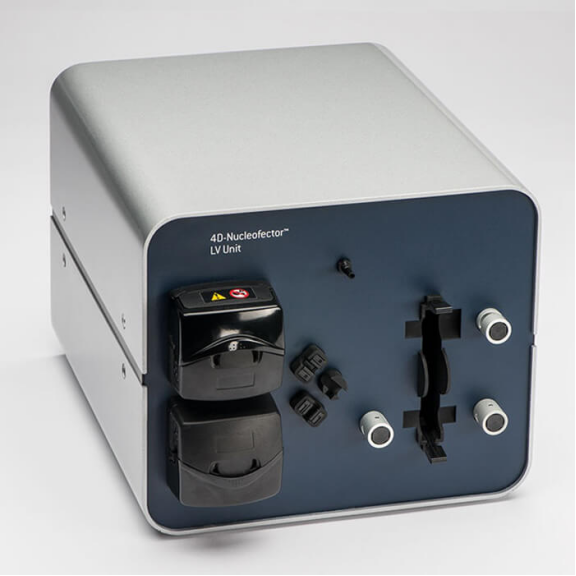
5、96孔模塊:用于同時(shí)轉(zhuǎn)染96個(gè)樣品的細(xì)胞,轉(zhuǎn)染細(xì)胞數(shù)量2×10^4至1×10^6。每個(gè)孔可獨(dú)立設(shè)置程序。必須與X模塊結(jié)合使用。
參考文獻(xiàn):
1.Engineering of CRISPR-Cas12b for human genome editing.Strecker J, et al. Nature (2019) 10(1): 212
2.Gene correction for SCID-X1 in long-term hematopoietic stem cells.Pavel-Dinu M, et al. Nat Commun. (2019) 10 (1): 1634
3.Orthotopic replacement of T-cell receptor a- and ?-chains with preservation of near-physiological T-cell function.Schober K, et al. Nat Biomed Eng (2019) 10: 01
4.Ribonucleoprotein Transfection for CRISPR/Cas9-Mediated Gene Knockout in Primary T Cells.Oh SA, et al. Curr Protoc Immunol (2019) 124(1): e69
5.Polymer-stabilized Cas9 nanoparticles and modified repair templates increase genome editing efficiency.Nguyen DN, et al. Nat Biotechnol (2019) 1: 1
6.CRISPR-Cas9 genome engineering of primary CD4+ T cells for the interrogation of HIV-host factor interactions. Hultquist JF, et al. Nat Protocols (2019) 14(1): 1-27
7.Bacteria-free minicircle DNA system to generate integration-free CAR-T cells.Chen Cheng, et al. J Med Genetics (2019) 56: 10–17
8.Genome-wide CRISPR Screens in Primary Human T Cells Reveal Key Regulators of Immune Function. Shifrut E, et al. Cell (2018) 175(7): 1985-1971
9.Guide Swap enables genome-scale pooled CRISPR-Cas9 screening in human primary cells. Ting PY, et al. Nat Methods (2018) 15(11)
10.Cytokines induced killer cells produced in good manufacturing practices conditions: identification of the most advantageous and safest expansion method in terms of viability, cellular growth and identity.Castiglia S,et al.J Transl Med (2018) 16: 237
11.A high-fidelity Cas9 mutant delivered as a ribonucleoprotein complex enables efficient gene editing in human hematopoietic stem and progenitor cells. Vakulskas CA,et al.Nat Med (2018) 24(8): 1216-1224
12.Reprogramming human T cell function and specificity with non-viral genome targeting.Roth TL,et al.Nature (2018) 559: 405-9
13.Nucleofection with Plasmid DNA for CRISPR/Cas9-Mediated Inactivation of Programmed Cell Death Protein 1 in CD133-Specific CAR T Cells.Hu B,et al.Hum Gene Ther (2018)
14.Optimized RNP transfection for highly efficient CRISPR/Cas9-mediated gene knockout in primary T cells.Seki A,et al.J Exp Med (2018) 215(3): 985-997
15.Improved Expansion and In Vivo Function of Patient T Cells by a Serum-free Medium.Medvec AR,et al.Mol Ther Methods Clin Dev. (2017) 7; 8: 65-74
16.Going non-viral: the Sleeping Beauty transposon system breaks on through to the clinical side.Hudecek M1,et al.Clin Exp Immunol (2017) 52(4): 355(80)
17.CRISPR-Mediated Integration of Large Gene Cassettes Using AAV Donor Vectors.Bak RO,et al.Cell Rep (2017) 20(3): 750-756
18.CRISPR-Cas9 mediated LAG-3 disruption in CAR-T cells.Zhang Y,et al.Frontiers in Immunology (2017) 1: 1-9
19.CRISPR/Cas9-mediated PD-1 disruption enhances anti-tumor efficacy of human chimeric antigen receptor T cells.Rupp LJ1,et al.Scientific Reports (2017) 7 (1): 737
20.A genome-wide CRISPR screen identifies a restricted set of HIV host dependency factors.Park RJ, et al.Nat Genet (2017) 49(2): 193-203
13269190901

掃碼加微信

 我的位置:
我的位置:
